Types of Permits for Manaslu Trekking
The Manaslu Circuit Trek passes through both the Manaslu Conservation Area and the Annapurna Conservation Area. Trekkers must obtain the Manaslu Restricted Area Permit (RAP), Manaslu Conservation Area Permit (MCAP), Annapurna Conservation Area Permit (ACAP), and the Chumnubri Rural Municipality Entrance Permit. If your itinerary includes Tsum Valley, a separate Tsum Valley Restricted Area Permit is also required. Unlike many other trekking regions in Nepal, a TIMS (Trekkers' Information Management System) card is not required for the Manaslu Circuit Trek because the Restricted Area Permit already serves as the official registration system.
- Manaslu Conservation Area Permit
- Annapurna Conservation Area Permit
- Manaslu Restricted Area Permit (for Jagat village and above)
- Chumnubri Rural Municipality Entrance Permit
- Tsum Valley Permit
The number of permits a trekker requires depends on the route they choose. For instance, if you are just trekking to the Manaslu Tsum Valley Trek, you just need the MCAP, Tsum Valley permit, Chumnubri Rural Municipality Entrance Permit, and Manaslu Restricted Area Permit. And for the Manaslu Circuit Trek, you require 4 permits: MCAP, ACAP, Manaslu RAP, and a Chumnubri Rural Municipality Entrance Permit
Price from
US$1585
Sacred Valley Trek
What are the Costs of Manaslu Trek Permits?
Manaslu Conservation Area permit fee:
- Entry fee for SAARC: NPR 1000 per person
- Entry fee for other nationals: NPR 3000 per person
(Required for those above 10 years of age)
Annapurna Conservation Area permit fee:
- Entry fee for SAARC: NPR 1000 per person
- Entry fee for other nationals: NPR 3000 per person
(Required for those above 10 years of age)
Manaslu Restricted Area Permit Fee:
- In peak season, September-November (Autumn): USD 70 for the first seven days and USD 10 for each additional day.
- In the off-season, December – August (Winter): USD 50 for the first seven days and USD 7 for each additional day.
For SAARC Countries:
- Group trekkers: NPR 300
- Individual trekkers: NPR 600
For other Nationals:
- For group trekkers: NPR 1000
- For Individual trekkers: NPR 2000
Tsum Valley Permit Fee:
- During the peak season, from September to November, USD 35.00 per person for the first 8 days.
- During the off-season, from December to August, USD 25.00 per person for the first 8 days.
Trekkers extending into Tsum Valley need a fifth permit, the Tsum Valley Permit. Trekkers should also budget for the Chumnubri Rural Municipality fee, NPR 1000, a local charge collected at the start of the trek at Jagat rather than during the Kathmandu paperwork stage, and covered in detail further below.
| Permit |
Required for |
Cost |
Where Issued |
| RAP |
Restricted Area |
Seasonal |
Immigration |
| MCAP |
Conservation |
NPR 3,000 |
NTB |
| ACAP |
Conservation |
NPR 3,000 |
NTB |
| Chumnubri |
Local Municipality |
NPR 1,000 |
Jagat |
| Tsum |
Restricted Area |
Seasonal |
Immigration |
Price from
US$1235
Sacred Valley of Trans Himalaya
Figure: Tabular diagram of permits in Manaslu Region
Note: Permit fees are subject to change by the Government of Nepal without prior notice. Always confirm the latest rates before your trek.
Why don’t we need the Trekkers’ Information Management System (TIMS) Card for Manaslu Trekking?
The TIMS card exists to track independent trekkers moving through Nepal's open, unrestricted trekking areas like Everest and Annapurna's standard trekking routes. It works as a general registration and database system so authorities have a record of who is on which trail.
Manaslu doesn't need it because the Restricted Area Permit already does that job, and does it more thoroughly. The RAP system requires every trekker to be registered with a specific licensed agency, travel with a named guide, and follow a fixed itinerary that gets logged with the Department of Immigration before you even start walking. Since the government already knows exactly who is entering the restricted zone, when, and with which agency, a separate TIMS registration would just be duplicating information that RAP already covers.
This is actually a common source of confusion in older blog posts and outdated trekking guides; some still list TIMS as a requirement for Manaslu because that used to be standard advice years ago, before the restricted area system was tightened. Trekkers who go by that old information sometimes arrive in Kathmandu having budgeted for a card they don't need, or waste time trying to get one from the Nepal Tourism Board before realizing the RAP already has them covered.
The one place TIMS still applies on a Manaslu itinerary is the Annapurna Conservation Area section near Dharapani, but even there, ACAP is the permit that governs entry rather than TIMS.
What are the Rules for the Manaslu Trek?
The Nepal Government has declared certain parts of the Manaslu Region a restricted area to control tourism in the region, which would support and preserve the authenticity of the Manaslu Area, either in terms of nature or culture. Other rules related to the Manaslu Trek Region
- Independent trekkers are not allowed
- Trekkers are subject to a special permit,
- Minimum of two trekkers in a group
- Accompanied by a Local Guide
- Manaslu Restricted Area Permit (Manaslu RAP) must be processed through a Registered Agency.
- Freelance guides cannot issue the necessary permit for the Manaslu Trek.
Why You Cannot Trek Manaslu Alone?
Solo trekking is not permitted anywhere along the Manaslu Region. This is not a suggestion or a safety recommendation from agencies like ours; it is a government rule tied directly to the Restricted Area Permit. The RAP can only be issued to a minimum of two trekkers traveling together, and it must be processed through a registered agency with a licensed guide attached.
Here are a few reasons you cannot trek Manaslu alone.
- The trail passes through remote villages with limited infrastructure, and rescue response times in bad weather can stretch far longer than trekkers expect. A guide on the ground makes the difference between a manageable problem and a genuine emergency.
- The route also runs close to the Tibet border, and parts of the trail fall inside a security-sensitive zone that the government prefers to keep monitored through licensed guides and registered agencies rather than open to independent travelers.
- Cultural sensitivity plays a role, too. Villages here maintain traditions and ways of life that have stayed largely undisturbed compared to busier trekking regions. A local guide helps trekkers navigate these customs respectfully, from monastery etiquette to interactions with locals who may not speak much English.
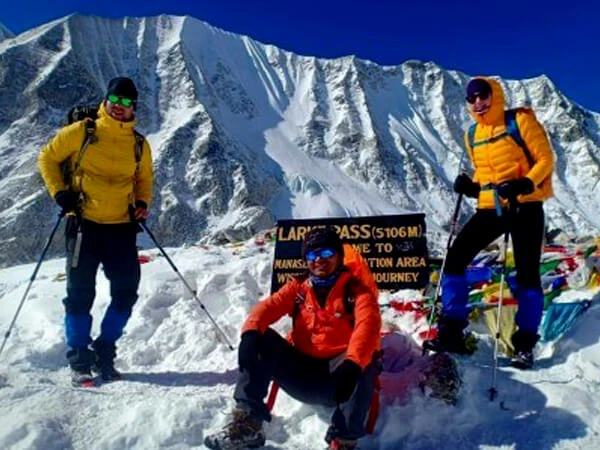
- Altitude is another major factor. The Manaslu Circuit crosses the Larkya La Pass at over 5100 meters, and altitude sickness can develop quickly and unpredictably even in trekkers who feel fine the day before. A guide recognizes early symptoms, knows when to slow the itinerary down or descend, and can coordinate a rescue quickly if a situation turns serious — something a solo trekker without local support cannot do for themselves at that altitude.
Why are guides mandatory in this region?
Manaslu is genuinely remote in ways that Everest and Annapurna are not anymore. Trail conditions change fast, signage is minimal in several sections, and the path between Jagat and Samagaun involves exposed sections, landslide-prone stretches, and river crossings that shift year to year depending on monsoon damage. Teahouses thin out considerably past Deng, and options for food, charging, and even basic supplies become limited the higher you climb. A guide who knows the route and the seasonal changes in trail condition is not a luxury here; it is what keeps a trek on schedule and safe. Communication is another factor. Many villages along the restricted section speak Nepali or Tibetan-influenced dialects as a first language, and a guide bridges that gap for everything from ordering food to navigating a health issue at altitude.
Why is the Annapurna Conservation Area Project (ACAP) permit needed for the Manaslu Trek?
If the itinerary includes the area of the Annapurna Conservation Area Project, then you will need an ACAP permit, though you may travel only for 1 or 2 days. Usually, the Manaslu Trek itinerary includes the route of ACAP, such as Dharapani and Samagaun.
ACAP and MCAP Entry Permit Rules and Conditions
- The permit allows single entry only, valid for the designated areas within the conservation area.
- Permit holders must follow the National Park and Wildlife Conservation Act 2029 B.S. (1973) and its regulations.
- Carry the permit for the entire trip and show it if conservation area staff ask.
- Children below 10 years do not need a permit.
- Drones are strictly prohibited unless prior approval is granted.
- Some zones inside the ACA and MCA are further restricted, with permits issued through the Department of Immigration. Mountaineering permits come separately from the Nepal Mountaineering Association.
- Documentary filming needs approval from the Ministry of Information and Communication, along with NTNC.
- Registering at check posts along the route helps authorities track trekker flow and speeds up rescue response in an emergency.
- Hunting is prohibited. Fishing requires a separate permit from the local Conservation Area Management Committee, available through your lodge.
- Collecting scientific specimens needs prior NTNC approval.
- Trekkers should follow the Minimum Impact Code, and agencies should be prepared on the safety, legal, and environmental fronts.
How to Pay the ACAP and MCAP Entry Fee
Online Payment
Online payment sends your permit by email once payment clears, so a counter visit is not needed. It accepts Visa and Mastercard, with an added 2.9 percent payment gateway charge.
Counter Payment
Counter payment means visiting the Entry Permit counter in person and paying cash, with your passport or valid ID on hand. No extra charge applies here.
Permits issued directly at check posts along the trail cost double, so arranging permits in Kathmandu or Pokhara beforehand is always the better option.
Requirement for a Manaslu Trek Permit
To receive the Manaslu Trek permit, trekkers have to submit documents:
- Original passport with Nepal visa
- 4 passport-size photos
- Travel Insurance (must cover emergency evacuation up to 6000m)
- Permit fees ( Manaslu Trekking packages’ cost includes permit fees)
Manaslu Permit Application Process
Getting the Manaslu Restricted Area Permit takes more than a same-day counter visit. Trekking agencies typically handle it in three stages.
- Stage 1: Submit the trekking application along with ACAP and MCAP forms, your printed itinerary, and passport copies to the Department of Immigration.
- Stage 2: Visit the Department of Immigration in Anamnagar with your documents, deposit the permit fee in US dollars at the on-site bank counter, and go through officer verification before the Director General signs off and the permit stickers are printed and stamped.
- Stage 3: Visit the Nepal Tourism Board office to process MCAP and ACAP, attaching printed photographs before NTB signs and issues the permits.
Because of this multi-step process, booking through a registered agency like Nepal Adventure Team makes permit collection far easier. Independent trekkers cannot complete this process alone since solo trekking is not permitted in the Manaslu region. Planning your trek next? Read our complete Manaslu Circuit Trek Guide for itinerary, costs, accommodation, and preparation tips.
Tips to Get Your Manaslu Circuit Permit Without Delays
- Book through a registered agency early. Since the RAP can only be processed through a licensed trekking company, starting the process 10 to 15 days before your trek date avoids last-minute stress.
- Team up with a trekking partner. Since solo applications are not accepted, sort out your second trekker before you begin any paperwork.
- Get your travel insurance sorted first. Insurance covering evacuation up to 6000 meters is a mandatory document, and immigration will not process your permit without it.
- Carry extra passport photos. Bring more than the required 4 copies since local offices sometimes ask for spares if a print is smudged or the wrong size.
- Double-check your visa validity. Your Nepal visa needs to cover your entire trekking period, including buffer days for weather delays.
- Avoid peak season lines by applying slightly ahead. September through November sees the highest volume of RAP applications, so early submission avoids office backlog.
- Keep both digital and printed copies of every permit. Some check posts still prefer physical copies even when a digital one is available.
Based on our experience arranging Manaslu treks, the most frequent issues are expired Nepal visas, missing passport photos, and insurance policies without high-altitude evacuation coverage. Verifying these documents a few days before applying helps ensure a smooth permit process. At Nepal Adventure Team, we've helped hundreds of trekkers obtain Manaslu permits over the years. One of the most common reasons for permit processing delays is incomplete travel insurance that doesn't include emergency helicopter evacuation above 6,000 meters. We recommend checking your insurance policy before submitting your permit application to avoid last-minute issues.
Common Mistakes to Avoid When Applying for Manaslu Permits
- Trying to apply as a solo trekker. The Manaslu RAP always requires a minimum of two trekkers, and applications from individuals are rejected outright.
- Assuming a freelance guide can process the permit. Only registered trekking agencies can submit RAP applications, so freelance arrangements will not work for this region.
- Skipping the ACAP because the itinerary "barely touches" the Annapurna Conservation Area. Even one or two days inside the ACA requires a full ACAP permit.
- Forgetting evacuation coverage on the insurance policy. General travel insurance without high-altitude evacuation coverage does not meet the permit requirement.
- Leaving permit arrangements until arrival in Kathmandu. The multi-stage immigration process takes time, and rushing it right before departure often causes travel delays.
- Losing track of permit copies mid-trek. Since permits must be shown at every check post, misplacing them can hold up your group significantly.
- Not accounting for extra RAP days. Trekkers who extend their itinerary beyond the initial permitted days without informing their agency face additional daily fees that catch them off guard.
Final Thoughts: Manaslu Trek
Understanding the Manaslu permit system before your trek can save time, money, and unnecessary stress. Since permit requirements, fees, and regulations can change, it's always best to confirm the latest information before your departure. Whether you're planning the standard Manaslu Circuit or extending your trek into Tsum Valley, arranging your permits through a licensed trekking agency ensures you meet all government requirements and can focus on enjoying one of Nepal's most rewarding trekking experiences. With years of experience organizing guided treks in the Manaslu region, Nepal Adventure Team stays up to date with the latest permit regulations and trekking requirements. From obtaining restricted area permits to planning your itinerary and arranging experienced guides, we handle the entire process so you can focus on enjoying your adventure.