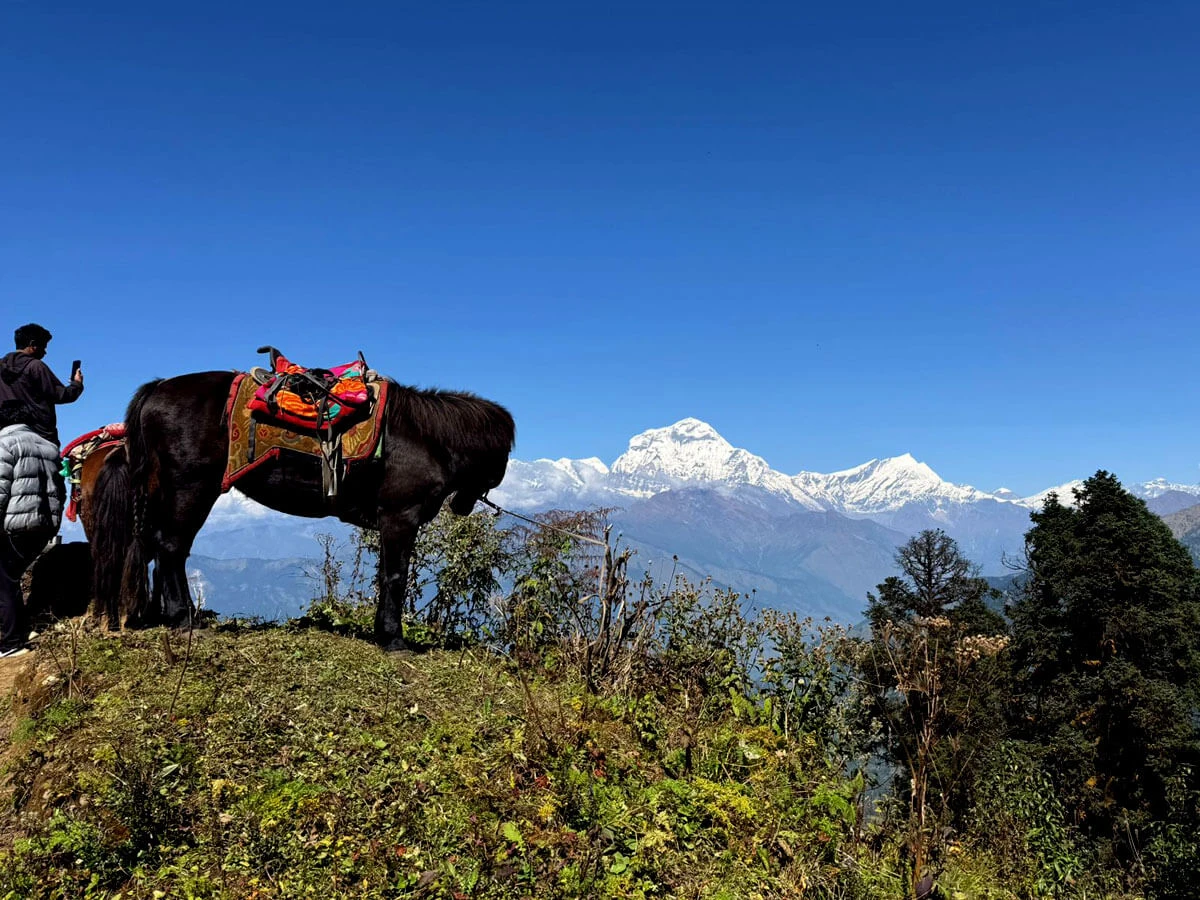
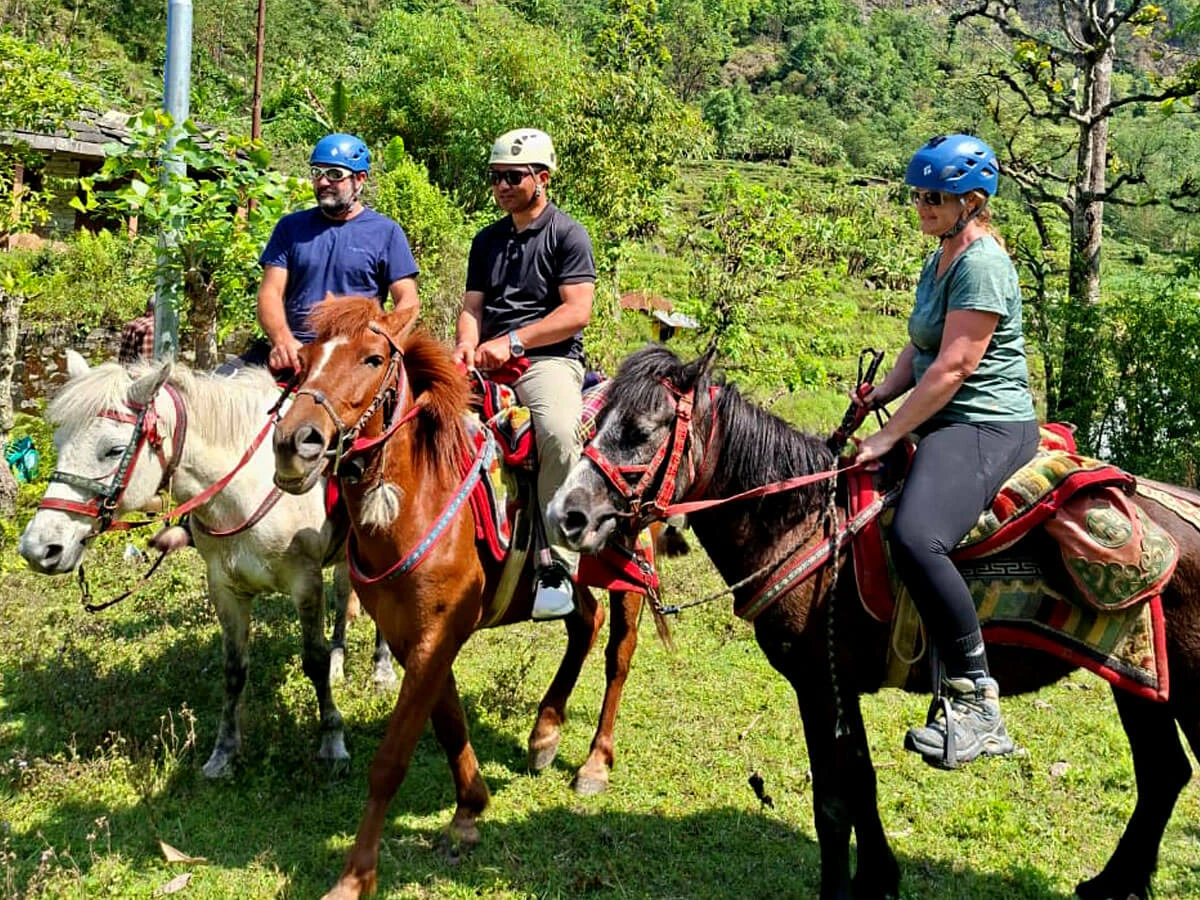
The 8-Day Poon Hill Horse Riding Trek is a beautiful, beginner-friendly activity done in Nepal's Annapurna region, welcoming anyone to experience the joy of riding gentle local ponies. You will ride sturdy local ponies for 3 to 5 hours a day, starting at Birethanti (860m) and finishing at Kande (1,770m). The spring and autumn seasons are the best time to go for the Poon Hill Horse riding Trek. The views are beautiful, taking you past waterfalls, green farms, and local villages. If you go in the spring, you will also ride through forests filled with blooming rhododendron flowers. The best part of the trip is reaching Poon Hill (3,210m), which is the highest point of the trek, to watch a stunning sunrise over giant, snow-capped mountains like Dhaulagiri and the Annapurna range. While the price changes depending on the season you choose, Our Team will handle all the permits, horses, guides, and planning.
Poon Hill Horse Riding Trek
Trip Facts
The Poon Hill Horse Riding Trek is one of the most rewarding and distinctive riding journeys available in the Himalaya, and it remains far more personal and uncrowded than it sounds. The trail itself has been used by pack horses for generations. The ponies know it. The horsemen know it. What you experience on the back of a horse here is not an adventure sport or a novelty. It is the original character of this route, returned to. The route passes through Gurung and Magar territory, communities with centuries of connection to these hills and to the pack horse trade that originally built these trails. Riding this circuit is not just a scenic journey. It is a return to the way this landscape has always been travelled.
Our Team customises every Poon Hill ponies Trek around your group, your pace, and your interests. We also offer other Nepal trekking and riding packages. You can choose from our Annapurna Base Camp Trek, Everest Base Camp Trek, or Ghorepani Poon Hill Trek on foot if the full riding experience is not what you are looking for.
Why is the Poon Hill Horse Riding Trek Worth to experience?
Horse Riding vs Trekking to Poon Hill: Which Is Right for You?
This is the question most visitors ask before booking. Both routes follow the same Ghorepani Ghandruk circuit. The trail, the teahouses, the views, and the Poon Hill sunrise are all the same. What changes completely is the experience of getting there.
On foot, the Ghorepani Poon Hill Trek demands full physical attention for four to seven hours a day. The effort is real, especially on the stone staircase sections above Tikhedhunga and the climb to Ghorepani. For fit, experienced trekkers, that effort is the point.
On horseback, the effort is carried by the animal. Your attention is free for the mountains, the forest, the villages, and the people you pass. The pace is unhurried. The perspective from the horseback (saddle), slightly elevated, looking out across the valley, changes what you see and how you see it. Most riders describe it as the most relaxed and immersive way they have ever experienced a Himalayan route.
Who Should Choose the Horse Riding Version?
- Families with children who are comfortable on horseback
- Older travellers who want the Annapurna region without multi-hour daily walking
- First-time visitors to Nepal with one week available who want a different kind of Himalayan experience
- Photographers who want to shoot from the saddle and move at the pace of the landscape
- Anyone who has already walked the Ghorepani circuit and wants to experience it in a completely new way
Note: While this trip is fantastic for beginners, it may not suit everyone. If you have severe lower back, hip, or joint issues, please check with your doctor first because riding for hours can be tough on those areas. Also, if you are looking for a high-altitude challenge above 4,000 meters, this trek is too low; you should consider the Annapurna Base Camp Trek instead. Or you can join our Mardi Himal Trek package. Finally, it is best to avoid booking from June to August, as the heavy monsoon rains make the mountain trails far too muddy and slippery for horses.
Poon Hill Horse Riding Trek Highlights
- Ride sturdy Himalayan mountain ponies through the Ghorepani-Ghandruk circuit in the Annapurna Conservation Area
- Watch the dawn alpenglow on Annapurna I, Annapurna South, Dhaulagiri, Machhapuchhre, and Hiunchuli from Poon Hill (3,210m)
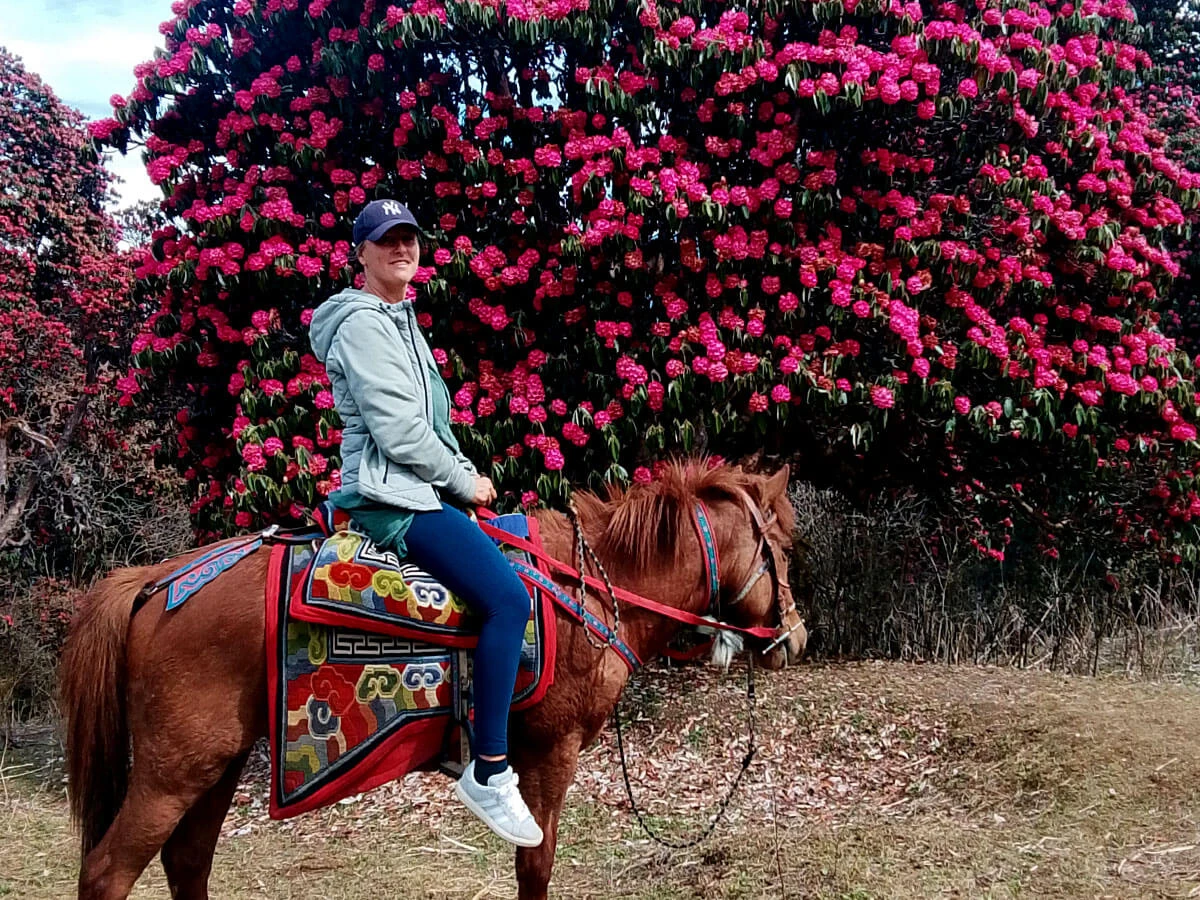
- Ride through dense rhododendron forest, spectacular in bloom from March through April, one of the most beautiful trail environments in the Himalaya
- Visit Ghorepani, Ghandruk, and Deurali: traditional Gurung and Magar villages at the heart of the Annapurna foothills
- No prior riding experience required; experienced horsemen accompany every rider throughout the journey
- Experience the Annapurna foothills at the natural pace of mountain horse travel
- A complete loop circuit: Birethanti to Kande, covering the full Ghorepani-Ghandruk route
- Comfortable teahouse accommodation and full meals throughout the trail days
- All permits, horses, horsemen, guides, and porter service included
Poon Hill Horse Riding Trek During Spring Rhododendron Season
The rhododendron blooms along the trail between Birethanti and Ghorepani peaks in late March and through April. This is the single most visually spectacular feature of the entire route. From Tikhedhunga upward, the forest canopy is roofed with red and pink blooms, and the trail surface is carpeted with fallen petals. The horses move through it at walking pace, and the light through the flowering rhododendron at this altitude is unlike anything you will find lower down.
Spring departures during the bloom window book out faster than any other time of year. If March or April is your target, book early.
Poon Hill Horse Riding Trek: Trail Route, Riding Experience, and Circuit Map
The trek departs from Birethanti (860m) at the entrance to the Modi Khola valley and follows the Ghorepani-Ghandruk circuit clockwise, returning to the roadhead at Kande (1,770m) on Day 7.
Route Highlights Along the Way:
- Modi Khola river valley, as you ride north from Birethanti
- Terraced farmland and subtropical forest on the lower trail
- Stone staircase sections above Tikhedhunga transitioning into the rhododendron belt
- Ulleri village with wide valley views before the approach to Ghorepani
- Poon Hill viewpoint (3,210m) on foot at sunrise, Annapurna I, Annapurna South, Dhaulagiri, Machhapuchhre, and Hiunchuli on a single horizon
- Descent through Tadapani and rhododendron forest to Ghandruk
- Traverse through Kimche to Deurali with Machhapuchhre prominent throughout
- Final descent through the forest to the Kande roadhead
Mountains Visible During the Trek:
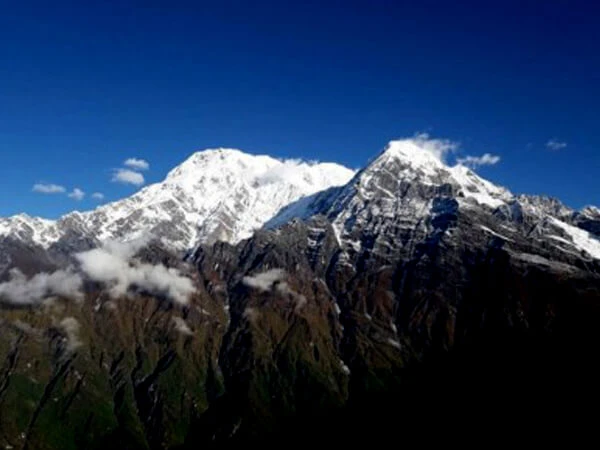
Annapurna I (8,091m), Annapurna South (7,219m), Dhaulagiri (8,167m), Machhapuchhre (6,993m), Hiunchuli (6,441m), Gangapurna (7,455m), Annapurna III (7,555m), and Lamjung Himal (6,986m).
The trail also passes directly through the traditional territories of the Gurung and Magar peoples, two of the indigenous hill communities of the Annapurna region with deep historical connections to this landscape. Ghorepani is a Gurung settlement. Ulleri and the lower valley villages are predominantly Magar. Ghandruk is shared between the Gurung and Magar communities and remains one of the best-preserved examples of traditional hill village architecture and culture in western Nepal.
Why Choose Nepal Adventure Team for Your Poon Hill Horse Riding Trek
When you walk through Thamel, you will find no shortage of operators offering horse riding treks and trekking packages in Nepal. The pictures look similar. The routes are the same. What actually separates one operator from another is not the horse or the trail. It is the people managing your experience before, during, and after the trek.
- We Know the Route Personally: Our team has ridden and walked the Ghorepani-Ghandruk circuit many times. We know the trail conditions by season, the teahouses worth staying in, the best light for photography at Poon Hill, and the sections where horses need to be walked. This is not a route we manage from a desk.
- Transparent Pricing, No Surprises: We give you one clear price before you book. No hidden permit costs. No unexpected additions on the morning of departure.
- Small Groups, Real Attention: We keep our groups small deliberately. We know your name, your schedule, and your riding experience before you arrive in Pokhara. The Poon Hill Horse Riding Trek is planned around you.
- Safety Is Our Baseline, Not Our Pitch: Our horsemen are experienced locals with deep knowledge of the Annapurna foothills trails and the animals they work with. Weather decisions are made by people who know these mountains, not by a booking schedule.
- We Handle Everything: Permits, horses, horsemen, guides, porters, vehicle transfers, and teahouse bookings are all arranged before you arrive. All you need to do is show up at the vehicle at the agreed time.
- Honest When the Weather Wins: If trail conditions make riding unsafe, your itinerary is adjusted at no extra cost. If you prefer not to reschedule, we will discuss the best solution for your situation.
- Built on Word of Mouth: Most of our clients come through recommendations from past travellers. We have built our reputation over years of operating trekking and riding packages in Nepal, and we protect it on every single trip.
What to Expect During the Poon Hill Horse Riding Trek
Riding on Himalayan Mountain Ponies:
The ponies used on this route are local mountain animals, compact and sure-footed, that have worked the Annapurna foothills trails for generations as pack animals. They know the paths, the gradients, and the rest stops. Each horse is paired with a local horseman who walks alongside, manages the animal on difficult sections, and assists with mounting and dismounting. You do not manage the horse independently. The riding is traditional mountain horse travel, not an adventure sport.
Breathtaking Himalayan Scenery:
The trail from Birethanti to Ghorepani and back through Ghandruk passes through some of the most varied and beautiful terrain in the Annapurna region, river valleys, terraced farmland, oak and rhododendron forest, high ridges, and traditional villages, all within a compact loop. The Annapurna massif, Dhaulagiri, and Machhapuchhre are visible for multiple days of the trek.
Poon Hill Sunrise:
On the morning of Day 5, you rise at 4:30 AM and climb Poon Hill on foot in roughly 45 minutes. The viewing tower sits at 3,210 metres, and the panorama at first light- Annapurna I, Annapurna South, Dhaulagiri, Machhapuchhre, and Hiunchuli in alpenglow — is the defining image of this entire region. No photograph quite prepares you for it.
Gurung Village Culture:
The trail passes through Gurung and Magar villages, where stone-paved lanes, traditional houses, and local life continue largely unchanged. Ghandruk, the largest Gurung village in the Annapurna foothills, has a small heritage museum and a warm community atmosphere that most trekkers move through too quickly on foot.
Comfortable Teahouse Accommodation:
The teahouses along this circuit are well-established, reliable, and incredibly welcoming. Warm meals, hot drinks, and simple but clean twin rooms are available at every overnight stop. This is not wild camping. You sleep well and eat well every night. It is the perfect balance of a true Himalayan adventure during the day and a safe, comfortable, and well-fed rest every single night.
Expert Horsemen and Experienced Guides:
Your team on the trail is made up of true mountain experts. The horsemen come from local families who have lived and worked with animals in the Modi Khola valley for generations. Because of this, they know the trails perfectly and know exactly how to take great care of both you and the mountain ponies.
Your trekking guide speaks clear English and handles everything for you from start to finish. They manage all the daily planning between Birethanti and Kande, like checking permits and booking your teahouse rooms. Having them with you means you never have to worry about the details—you can relax, ask questions, and enjoy the beautiful ride.
Fully Customized Itinerary:
If you want to experience the local culture, you can spend more time exploring the beautiful village of Ghandruk. We can also add a full rest day in Ghorepani so you and your pony can relax. For photography enthusiasts, we can arrange a special morning before the Poon Hill climb, allowing you to capture stunning mountain views without feeling rushed. This is your Poon Hill Horse Riding Trek, and we built it around what you actually want from the eight days.
Ideal for All Kinds of Travellers:
Families with children who ride, older travellers who want the Annapurna region without the physical demands of full-day walking, first-time visitors to Nepal with a week available, and anyone who wants a different and more personal relationship with this landscape than walking gives you.
Challenges to Be Aware of During the Poon Hill Horse Riding Trek
Weather and Trail Conditions:
The trail above Banthanti can carry light snowfall in January and February. Monsoon season from June through August brings slippery conditions and leeches in the lower forest sections, which is why we do not recommend this route during the monsoon. We monitor conditions carefully and will not ride unsafe sections.
Altitude Considerations:
The highest overnight stop is Ghorepani at 2,860 metres, and the maximum altitude reached is Poon Hill at 3,210 metres. Serious altitude sickness is not a significant concern at these elevations, but mild headache or breathlessness is possible on the first night at Ghorepani, particularly for trekkers arriving from low altitudes. Drink water, move slowly, and inform your guide of any symptoms immediately.
Riding Comfort:
Riding days range from three to five hours in the saddle. Riders with lower back conditions, hip problems, or joint injuries should consult their doctor before booking. On steep or narrow sections, your horseman may ask you to dismount and walk a short distance. Always follow these instructions.
Weight and Baggage:
You do not have to worry about carrying heavy bags while riding. A professional porter will carry your main luggage from one overnight stop to the next throughout the entire trek.
All you need to bring on your horse is a small, lightweight daypack. Inside, you only need to pack your daily essentials like water, snacks, a rain jacket, a camera, and your travel documents. This keeps your ride light, comfortable, and completely stress-free!
Outline Itinerary
Poon Hill Horse Riding Trek Itinerary
Arrival in Kathmandu (1,400m)
Our Team representative meets you at Tribhuvan International Airport and transfers you to your hotel in Thamel. The rest of the day is free to rest, explore the streets around Thamel, or do any last-minute gear shopping. Your guide visits in the evening for a pre-trek briefing covering the itinerary, packing, permits, and what to expect on the trail and in the saddle.
Drive to Pokhara (820m)
An early morning departure from Kathmandu by private tourist vehicle takes you along the Prithvi Highway to Pokhara, following the Trishuli and Marsyangdi river valleys for much of the journey. Pokhara sits at the edge of Phewa Lake with the Annapurna range and Machhapuchhre rising sharply to the north. The contrast from Kathmandu is immediate. The afternoon is free for a lakeside walk, a boat on Phewa Lake, or rest before an early night.
Drive to Birethanti and Ride to Banthanti (2,200m)
A short vehicle transfer from Pokhara takes you to Birethanti, a riverside village at the entrance to the Modi Khola valley and the starting point of the Ghorepani circuit. Your horses and horsemen are waiting here at the Annapurna Conservation Area Permit (ACAP) checkpoint. After permit checks and a brief introduction to your horse, the riding begins. The trail climbs steadily through Tikhedhunga and past the long stone staircase section above it, moving through forest and terraced farmland before levelling out toward Banthanti. The forest begins to shift from oak to rhododendron as you gain height. Banthanti sits at 2,200 metres on the southern ridge of the Annapurna Conservation Area, a small cluster of teahouses in the middle of the rhododendron belt that marks the transition point between the lower Modi Khola valley and the high Ghorepani saddle above.
Ride to Ghorepani (2,860m)
Today's ride is shorter in distance but rewards you with the most beautiful trail environment on the entire route. The path from Banthanti to Ghorepani passes through dense rhododendron forest in spring, the trail is roofed with red and pink blooms, and the forest floor is carpeted with fallen petals. Ulleri village, with its traditional stone houses and long mountain views, is a natural rest stop before the final approach to Ghorepani. Ulleri is a traditional Magar village, one of the largest settlements on this section of the trail, known for its long stone staircase approach and wide terraced farmland. The village sits on a broad saddle with Dhaulagiri and the Annapurna massif visible on both sides. Ghorepani is a traditional Gurung settlement sitting at 2,860 metres on the ridge between the Modi Khola and Kali Gandaki valleys. The name means "horse water" in Nepali, a reference to the village's long history as a rest stop for pack horses and mule trains on the old trade route between the hills and Mustang. That history makes it a fitting overnight stop on a horse riding trek. The afternoon is free to rest and prepare for the early start the following morning.
Optional Poon Hill Sunrise, then Ride to Ghandruk (1,940m)
Wake at 4:30 AM for the optional hike to Poon Hill (3,210m). The climb takes roughly 45 minutes on foot and brings you to the viewing tower just before first light. On a clear morning, Annapurna I, Annapurna South, Dhaulagiri, Machhapuchhre, and Hiunchuli stretch across the full horizon, and the dawn alpenglow on these peaks is the defining image of the Ghorepani area. Return to Ghorepani for breakfast, then mount up. Tadapani sits at roughly 2,630 metres on the forested ridge between Ghorepani and Ghandruk, a small teahouse settlement surrounded by oak and rhododendron with outstanding views of Machhapuchhre and Annapurna South on a clear morning. It is one of the quietest and most atmospheric stops on the entire circuit. The trail descends through rhododendron forest to Tadapani and on to Ghandruk. Ghandruk is a dual Gurung and Magar settlement, the largest and most culturally intact village on this circuit, sitting at 1,940 metres on the southern flank of the Annapurna massif.
Ride to Pitam Deurali (2,100m)
From Ghandruk, the trail traverses the hillside through Kimche. Kimche is a small Gurung farming village at around 1,640 metres, a quiet settlement of stone houses and terraced fields that most trekkers pass through without stopping, and forested sections. Deurali sits at 2,100 metres on the ridge above the Modi Khola valley. The name Deurali means "pass" or "ridge settlement" in Nepali and is a common place name across the hills of Nepal. This particular Deurali marks the high point of the traverse between Ghandruk and the Kande descent. The riding today moves through a quieter section of the circuit, away from the main trekker traffic, with Machhapuchhre prominent to the north throughout the day.
Ride to Kande (1,770m), Drive back to Pokhara
The final riding day descends from Deurali through the forest to the roadhead at Kande. The air warms noticeably as you drop in elevation, and the valley opens below with Pokhara and Phewa Lake visible in the distance. At Kande, your vehicle is waiting. Horses are handed back to the horsemen, gear is loaded, and the drive returns you to Pokhara in time for a late lunch and a free afternoon by the lake.
Drive back to Kathmandu
A morning drive along the Prithvi Highway returns you to Kathmandu. Your vehicle drops you at your hotel or directly at Tribhuvan International Airport, depending on your onward flight schedule. If you have an evening departure, there is usually time for a last walk through Thamel, a farewell meal, or a visit to Pashupatinath or Boudhanath.
Poon Hill Horse Riding Trek Cost Details
Includes
- Airport pick-up and drop-off transfers in Kathmandu
- One night hotel accommodation in Kathmandu (twin sharing, bed and breakfast)
- Private tourist vehicle transfer from Kathmandu to Pokhara and from Pokhara to Kathmandu
- One night hotel accommodation in Pokhara (twin sharing, bed and breakfast)
- Mountain pony with experienced local horseman for each rider, Days 3 to 7
- Teahouse accommodation on the trail, twin sharing, Days 3 to 7 (5 nights)
- All meals on the trail: breakfast, lunch, and dinner, Days 3 to 7
- Annapurna Conservation Area Permit (ACAP)
- TIMS Card
- Experienced, government-licensed English-speaking trekking guide
- Porter service for personal gear (1 porter per 2 trekkers)
- Nepal Adventure Team trekking certificate
- Nepal Adventure Team duffle bag, t-shirt, and trekking map
- All government taxes and service charges
Excludes
- International airfare to and from Kathmandu
- Nepal entry visa fees (available on arrival at Tribhuvan International Airport)
- Lunch and dinner in Kathmandu and Pokhara
- Travel and medical insurance (mandatory — must cover horse riding, trekking to 3,500m, and emergency helicopter evacuation)
- Tips and gratuities for guides, horsemen, and porters
- Personal expenses: snacks, bottled water, hot showers, battery charging, Wi-Fi, and similar trail charges
- Any costs arising from weather, itinerary changes, or events beyond our control
Dates & Availability
Finding your perfect departure date for the 8-Day Poon Hill Horse Riding Trek is simple. A guaranteed date means the trip is 100% confirmed to run, so you can book right away, while an Available status means the date is wide open for new riders. If you see a date marked Limited, it means only a few spots and horses are left, so we encourage you to book soon before it becomes Closed for the season. If your favorite date is already full or running out of space, just send our team a quick message. We will happily help you find another beautiful date or set up a private horse-riding tour just for you! Here are the following dates for the Poon Hill Horse Riding Trek:
Add-Ons
Add a flight from Kathmandu to Pokhara.
Essential Information
When is the Best Season for the Poon Hill Horse Riding Trek
The Ghorepani Ghandruk circuit sits within the Annapurna Conservation Area, and the weather along it follows the same pattern as the broader Annapurna region. The two seasons that consistently deliver clear conditions and comfortable riding are spring and autumn.
Spring: Late February to May (Best for Rhododendron Bloom)
Spring, from late February through May, brings the rhododendron bloom, warming temperatures, and long afternoon light on the upper trail. March and April are the strongest months. The forest between Tikhedhunga and Ghorepani is at its most spectacular during this window, and the views from Poon Hill on a clear spring morning are among the finest you will find anywhere in Nepal. May can still work well, but requires more attention to afternoon cloud build-up.
Autumn: September to November (Best for Mountain Views)
Autumn, from late September through November, is the most reliable season for mountain visibility on this route. The post-monsoon air is clean and sharp, the skies hold clear from morning through mid-afternoon on most days, and the trail is at its best, maintained and most well-serviced. October is the peak month. November is quieter on the trail and equally rewarding.
Winter: December to February (Possible with Preparation)
Winter departures from December through February are possible. The trail can carry light snowfall above Banthanti in January and February, which adds atmosphere but requires warm gear and flexibility around the Poon Hill sunrise.
Monsoon: June to August (Not Recommended)
The monsoon season from June through August is not recommended for horse riding on this route due to slippery trail conditions and leeches in the lower forest sections. For 2026 and 2027, Nepal Adventure Team runs group departures throughout both main seasons. Private departures are available year-round on any date subject to horse and guide availability. Early booking is recommended for March and April, when demand is highest.
What to Pack during the Poonhill Horse Riding trek
Clothing:
- Thermal base layer worn under everything at Ghorepani — not just packed
- Thick fleece or light down jacket as primary insulation for evenings and the Poon Hill sunrise start
- Waterproof outer shell jacket and pants for rain and wind on the upper trail
- Trekking trousers (two pairs)
- Warm hat and sun hat
- Buff or neck gaiter
- Lightweight gloves and a warmer pair for Ghorepani and the Poon Hill climb
- Merino wool socks (four to five pairs)
Footwear:
- Sturdy closed-toe shoes or ankle boots with a slight heel for riding
- Camp sandals or light shoes for teahouses
- Trekking poles for the Poon Hill sunrise hike on foot
Equipment:
- Small daypack of 20 to 25 litres for use while riding
- Sleeping bag rated to minus 10°C — Ghorepani is cold overnight
- Headlamp with spare batteries for the 4:30 AM Poon Hill start
- Sunglasses with UV400 protection
- Sunscreen (SPF 50+) and lip balm
- Two one-litre water bottles or a hydration bladder
- Water purification tablets or a filter
- Camera and extra memory cards
Health and Safety:
- Personal first aid kit, including blister treatment
- Any prescription medications
- Hand sanitizer and wet wipes
- Travel and trekking insurance documents with the emergency contact number
What to Leave at the Hotel:
Everything that does not fit in a small daypack while riding. A porter carries your main bag throughout the trek, but keep it light. Excess luggage creates unnecessary difficulty at every overnight transition.
Permits Required for the Poon Hill Horse Riding Trek
Two permits are mandatory for the Poon Hill Horse Riding Trek as the route passes through the Annapurna Conservation Area. The Nepal government enforces this to protect the natural and cultural heritage of the conservation area and the communities within it.
- Annapurna Conservation Area Permit (ACAP) Issued by: National Trust for Nature Conservation (NTNC), Kathmandu or Pokhara Cost: NPR 3,000 per person (approximately USD 22–25) Required: Mandatory for all trekkers entering the Annapurna Conservation Area
- TIMS Card (Trekkers' Information Management System) Issued by: Nepal Tourism Board (NTB) or TAAN offices, Kathmandu or Pokhara Cost: USD 10–20 per person, depending on trekking type. Required: Mandatory for all trekkers in Nepal
Nepal Adventure Team arranges both permits on your behalf before the trek begins. Bring your passport and two passport-size photos for permit processing.
Poon Hill Horse Riding Trek Cost 2026
The cost of the Poon Hill Horse Riding Trek depends on the type of departure you choose and the size of your group. Private departures give you full flexibility and exclusive use of the guide, horsemen, and support crew, while group departures offer a more affordable per-person rate. All prices include ACAP permit, TIMS Card, horses and horsemen, guide, porter, teahouse accommodation, trail meals, and vehicle transfers. Nepal Adventure Team gives you one clear price before you book, with no hidden fees or last-minute additions.
For group bookings, customised itineraries, or last-minute availability, contact us directly at nepaladventureteam@gmail.com, and we will build the right package around your schedule and budget.
Types of Poon Hill Horse Riding Trek Service
Shared Group Joining Trek:
If you are looking for the most budget-friendly way to experience this journey, joining a scheduled group departure is your best option. By booking a set date, you get to share the overall trek expenses with fellow riders, which drops the per-person cost significantly compared to a private booking.
This option is highly recommended for solo travelers who want to meet new people along the trail, as well as couples or small groups of friends who have some flexibility with their holiday dates. To ensure the departure is guaranteed and everything runs smoothly, these group trips simply require a minimum of just two riders to set off into the mountains.
Private Departure:
If you want the ultimate freedom on the trail, you can book this trek as a private trip. This means your group gets exclusive, private access to your own guide, horsemen, and support crew for the entire journey. You will not have to share your team or match the pace of strangers.
This option gives you full control over the daily schedule. You can decide exactly when to start riding each morning, how fast or slow to go, and how often to stop for rests or photos. You can also easily add custom changes to the itinerary along the way. We highly recommend this choice for families traveling with children, couples looking for a personal getaway, or groups of friends who want to enjoy the mountains completely on their own terms.
Customized Package:
If you want the ultimate mountain experience, you can combine this horse riding trek with other famous trails in the Annapurna area. Instead of doing the standard loop, you can choose one of three amazing extensions to see even more:
- Annapurna Base Camp Trek: Ride deeper into the mountains to get right up close to the massive peaks.
- Mardi Himal Trek: Take a quieter, hidden trail that brings you closer to the beautiful Machapuchare (Fishtail) mountain.
- Khopra Danda Ridge Trek: Climb up to a high, scenic ridge for incredible, uncrowded views and a visit to a sacred mountain lake.
This is the most complete and rewarding way to see the foothills of the Annapurna range all in a single, unforgettable trip!
Special Packages for the Poon Hill Horse Riding Trek
Family Package:
Designed for families travelling with children or elderly members. Focused on comfortable daily riding distances, flexible scheduling, and the assurance that everything is handled before you arrive at the trailhead. Children who are comfortable on horseback are welcome from age eight upward.
Photography Package:
Extended time at Ghorepani timed around optimal morning light for the Poon Hill sunrise. Guidance on vantage points along the trail for mountain views and forest riding shots. Ideal for photographers who want the full visual range of the Annapurna foothills from both the saddle and the viewpoint.
Spring Rhododendron Package:
A departure specifically timed for the peak rhododendron bloom in late March and April. The trail between Tikhedhunga and Ghorepani during full bloom is unlike any other time of year. Nepal Adventure Team handles everything around your targeted bloom window.
Cultural Package:
Designed for travellers drawn to the living culture of the Gurung and Magar villages along the route. Extended time in Ghandruk, a visit to the local heritage museum, interactions with village communities, and a slower pace through each settlement. Flexible scheduling around local festival dates on request.
Poon Hill Horse Riding Trek FAQs
The full trek runs over eight days from arrival in Kathmandu to departure. Five of those days are spent on the trail between Birethanti and Kande, with two road transfer days and one buffer day in Kathmandu.
No upper age limit. Children from age eight upward who are comfortable on horseback are welcome. The trek is suitable for all age groups, including older travellers who want the Annapurna region without extended daily walking.
If trail conditions make riding unsafe, the itinerary is adjusted at no extra cost. We monitor conditions throughout and will always prioritise your safety and comfort over schedule.
Group departures run with a minimum of two riders and a maximum determined by horse availability. Private departures are available for any group size from one rider upward.
None at all. Each horse is managed by a dedicated horseman throughout the day. Complete beginners are welcome and make up the majority of riders on this trek each year.
Yes. The Annapurna Base Camp extension is one of our most popular customisations. After completing the Ghorepani-Ghandruk circuit, a vehicle transfer returns you to the Modi Khola valley for the ABC approach on foot. This extension adds approximately five to six days.
Yes. Private departures are our recommended option for families, and we handle all logistics, including permits, horses, horsemen, and teahouse arrangements.
Yes. You can book your Poon Hill Horse Riding Trek at nepaladventureteam.com or contact us directly at nepaladventureteam@gmail.com.
At least two to three weeks for standard group departures. Four to six weeks for spring departures in March and April, when demand is highest. Custom extension packages and private departures with specific date requirements need additional lead time.
Yes, it is possible, although informing us at least one week in advance gives us time to confirm horse availability and complete permit arrangements comfortably.
If you cancel more than seven days before departure, you receive a full refund. Cancellations within three to seven days incur a twenty percent fee. Cancellations within seventy-two hours are non-refundable. Weather and trail condition cancellations from our side are rescheduled at no extra cost or refunded in full.